Vacuum Excavation for Civil Engineering Projects
De-risking civils programmes through non-destructive ground investigation and service verification.
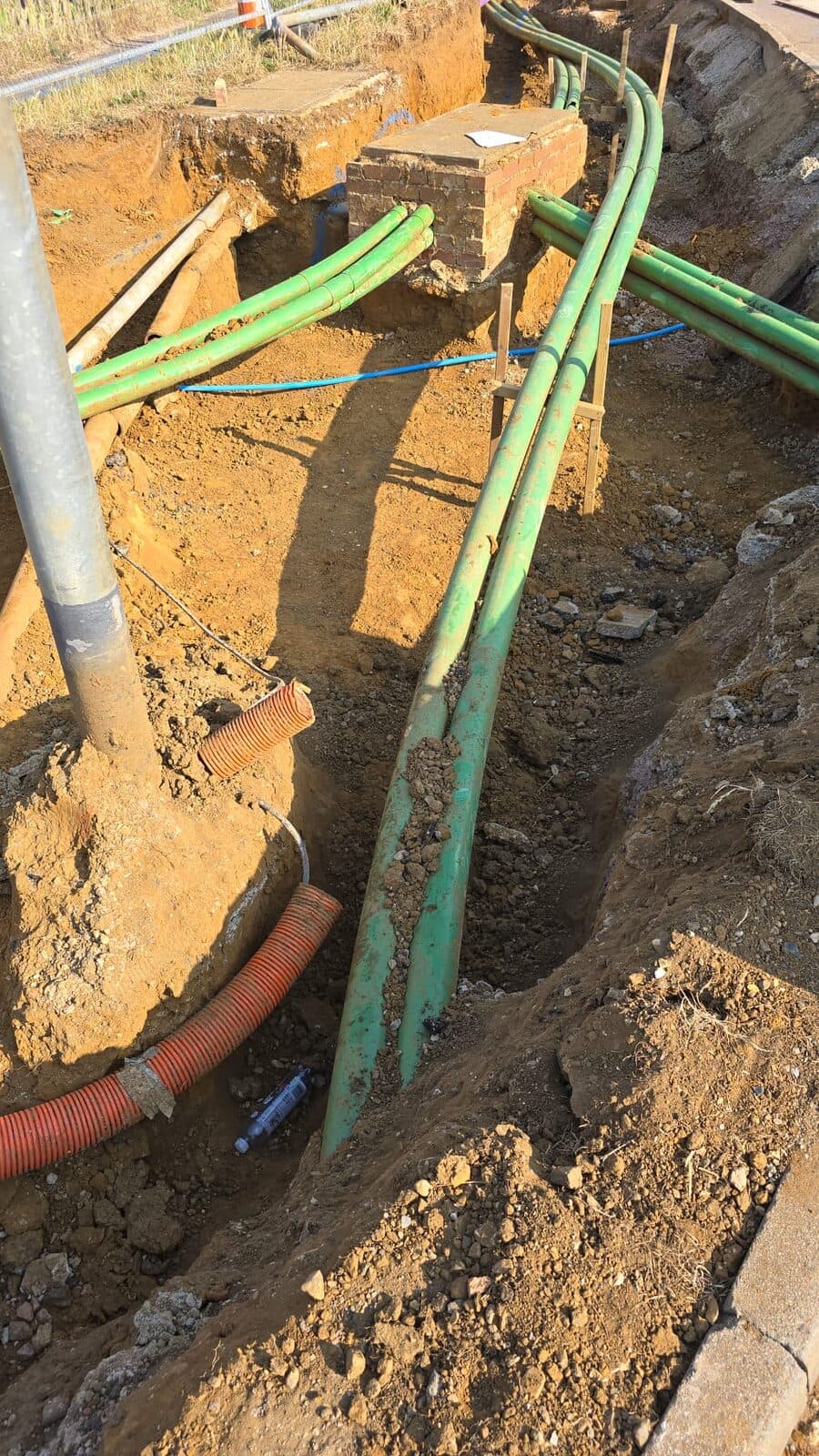
On a civil engineering programme, the biggest risks are usually the ones you can't see. Buried services that aren't where the records say, unexpected obstructions, ground that doesn't match the design model - each one has the potential to stop the works, trigger a service strike and turn a controlled programme into a sequence of delays, variations and safety investigations. Vacuum excavation is one of the most effective tools for taking that uncertainty off the table before it costs you.
Used early - in ground investigation, enabling works and service verification - non-destructive digging proves what's actually underground so the design can be validated and the main works package can proceed with confidence. When confirming service positions ahead of piling and foundations, digging trial holes to test a ground model, or clearing safely around existing infrastructure, the work is precise, evidence-led and low-impact.
How we support civils projects
Service verification
Confirming the position and depth of buried services before piling, foundations or deep excavation begin.
Trial holes
Fast, accurate trial holes to validate design assumptions and ground models against what's actually there.
Enabling works
Safe excavation around existing infrastructure to clear the way for the main works package.
Ground investigation
Non-destructive digging to support GI, inspection pits and sampling without damaging what's below.
What it protects
- Fewer service strikes
- Protected programme dates
- Evidence-led design
- Lower HSE exposure
- Controlled cost risk
Evidence, not assumption
Service records are a starting point, not a guarantee. On complex sites with multiple utilities, the safe approach is to prove positions and depths on the ground before committing plant and design to them. Our utility verification and trial holes and potholing services give your engineers confirmed data to work from - supporting PAS 128 surveys and keeping the programme moving.
De-risking a civils programme?
Send us the scope, location and dates and we'll come straight back with availability and a price. You'll speak to the operator - no call centres, no subcontractors.
SSIP Registered - SMAS Worksafe Contractor
Accredited for health and safety in construction procurement.

Frequently asked questions
- Where does vacuum excavation fit into a civils programme?
- Usually early - in ground investigation, enabling works and service verification before the heavy plant arrives. Proving what's underground before you pile, dig or pour means the main works can proceed with confidence instead of stopping for an unexpected strike.
- Can you verify services before piling or foundation works?
- Yes. We expose and confirm the exact position and depth of buried apparatus so your design and temporary works teams can work from evidence. That's particularly valuable on sites with dense or poorly recorded services, and it supports PAS 128 survey work.
- How does this de-risk our programme?
- A single service strike can trigger an HSE investigation, an emergency utility repair, standing plant and weeks of delay. Proving services non-destructively up front removes that risk at the point it's cheapest to manage - before the programme is committed to the ground.
- Do you work on complex sites with lots of buried services?
- That's where non-destructive digging earns its place. On congested brownfield and infrastructure sites we can work safely between and around multiple live services that mechanical excavation simply can't be trusted near.